Wednesday, December 19, 2007

A Nickelodeon Pregnancy

I had to post this because of my recent project on the sexualization of tweens. Not only is Jamie Lynn Spears the younger 16 year-old sister of the infamous Britney, but she is also a Nickelodeon star (she has her own TV show, Zoey 101)--a network (and show) most definitely geared toward the tween market. And now she's pregnant!

Perhaps some good can come out of this, serving as a lesson to younger girls that there are consequences for having sex, especially at such a young age. But, on the other hand, the attention Jamie is receiving as a result of this news could further encourage young girls that this is the behavior that is rewarded in our society today. Either way, it is an interesting follow-up to my final project.

Tuesday, December 11, 2007

Logo, Pathos, Ethos, and Oprah

Oprah. One word and you know exactly who we're talking about. She has inspired a nation of people to read through her book clubs and in turn blessed many up and coming authors with success. Mere mention of a product on her show creates instant public demand for the item. She is almost solely responsible for the fame and popularity of people like Dr. Phil and Dr. Oz. Oprah is such a strong example of ethos she almost deserves her own category as the 4th rhetorical strategy.

What is it about her that we trust and believe in so much? Despite her fame, her millions of dollars, and her extravagant lifestyle, we still find it possible to relate to her on a personal level. She has put herself out there in her struggles with weight, growing up disadvantaged, and her painful experience of being raped by a family member as a child. By living her life as a strong single woman who has a career yet supports motherhood, Oprah also appeals to the middle-aged woman demographic of today, which contains a great number of people. By being "like us," we connect emotionally to her, and she recognizes the power of that pathos response. Oprah has gained our trust and admiration, and we take her advice willingly, much to the benefit of the people and products she recommends.

Now that she is offering her input to the political arena for the very first time, it will be an interesting exercise in the power of Oprah rhetoric. Does her endorsement have the power to transcend boundaries and create a mass appeal that will help elect the first African American president? Maybe we should ask Dr. Phil.

Monday, December 10, 2007

The W&M Tribe

My roommate, a William and Mary alum and graphic designer by trade, has been outraged recently by the redesign of the William and Mary logo (see above). Similarly to the way the UB logo was redesigned, the graphic design department at the college (where she used to work) was not consulted in any manner, resulting in the heinous use of an obviously upside down W (check out the incorrect slant of the middle of the M) and a student body that is terribly upset by what has transpired (see this article for more details).

In talking to her a little more about the history of the logo, I came to find out that the initial reason for the redesign was that over a year ago, the NCAA deemed the logo offensive and, therefore, unfit to use in athletics. Before I saw the logo, I imagined it being something similar to the blatantly offensive Atlanta Braves cartoon Indian head. Instead, what I saw made me a little reluctant to believe the NCAA's ruling (see below).

While of course I do not agree with logos that are offensive to any one culture or race, I couldn't help but think that this was by far the least offensive of the Native American-influenced sports teams out there. What about the Washington Redskins, whose name itself is a flat-out racial slur? Or, in keeping with colleges, the Florida State Seminoles, which portray the stylized head of a Native American man as its logo (see below)?

In my mind, there seems to be a fishy arbitrariness about the NCAA's ruling. While I can understand wanting to promote tolerance, if all schools are not placed under the same restrictions, then what message is really being sent?

Sunday, December 9, 2007

Post Secret

http://postsecret.blogspot.com/
This site is one of my favorite exercises in visual/verbal rhetoric (and one of my favorite sites in general, for that matter). Every week, thousands of people send postcards into Frank, a Germantown, MD resident and artist, who selects some to post on his site and others to include in his books. While it does not encourage people to do any one thing in particular, it does persuade them to do one of the most private things--sharing a secret--in the most public way possible. I think that the rhetorical strategy behind the concept of the site involves the trust that Frank has developed in his audience through allowing people to post their deepest darkest fears and anxieties without being judged. Like good friends (which many people don't have), Frank and his community listen and include everyone without bias, promoting a feeling of trust that enables the site to maintain its popularity.

Frank does, however, play somewhat of a role in the creation of this emotion. While he shares some of the comments he receives about the posted secrets on the site with the public, he only includes positive messages, messages of help, or those that are similar to someone saying "I feel that way too." One week, he allowed all comments to be visible and it turned many people off from the site because a lot of people were critical of the secret-sharers, which created a sense of fear and anxiety in those contemplating sharing a secret. By carefully selecting which cards and comments to include, Frank provides the trust needed to make this site as effective as it is--it has even had the effect of helping a number of people who are in need of someone to listen, going so far to save the lives of some who are depressed and/or suicidal.

This site is also an exercise in juxtaposition and arrangement, as some of the cards carry different meanings when placed around others or arranged in a different way (such as the one below). The organization and arrangement of the postcards are also up to Frank's discretion, enabling him to evoke certain meanings through the way he places the cards on the site and in his books.


Tuesday, December 4, 2007

Curious George

I received this example of rhetoric in an email with a bunch of other images of children's books that displayed mischievously altered titles. The creator of this image obviously took something that is a beloved and easily recognizable childhood image (Curious George books), and by changing the title ever-so-slightly, makes a comment on the "absurdity" behind heightened homeland security. The altering of the familiar provides contrast, making it an effective rhetorical strategy for catching a reader's attention, and as a result, helping convince them of the intended message.

Pizza Tracking

I can't post this to the blog, but go to this link: ordering a pizza in 2010.

This funny movie was found on the ACLU's website. It's an obvious piece of rhetoric aimed at protecting the personal privacy and freedoms allegedly provided to Americans in the Constitution. Humor and exaggeration are utilized to show
just how far the concept of a "national id number" could take things in the future. The extreme to which this video takes this idea effectively emphasizes the author's point that the ease with which a national id number might allow the government keep track of citizens is not worth what would be given up in the way of personal freedom and privacy, in addition to the threat of identity issues (i.e., theft, etc.) that could result.

Tuesday, November 27, 2007

Toothpaste for Dinner

Toothpaste for Dinner cartoons are published daily, and utilize simplistic drawings and short, witty captions/dialogue to comment humorously on what are at times pertinent issues (and other times, they're just silly for the sake of being silly, which I also appreciate.)

I think one of the more interesting (and hilarious) things about these cartoons is that they always have the same strange square-headed characters in them. Perhaps it is the unity and simplicity of these designs that partially enables them to have the impact that they do. While for the most part their intent seems to be humor, they also work to point out the absurd and ridiculous things that happen in our society every day, challenging the public to take another look from a square-headed perspective for a change.

Thursday, November 22, 2007

Little Beauties

While watching TV with my roommate one night, we came across a documentary that simultaneously grabbed our attention and made us cringe uncontrollably. "Little Beauties" is a documentary-style special that follows the lives of beauty queens--all of whom are 6 years old or younger.

We watched mouths agape for an hour as these little girls were dolled up (literally) with makeup, outfits (including swimsuits), and even fake teeth, and then paraded around a stage to be judged on their appearances. At the end of the program, we swore this was something we would never do to our daughters.

Yet, upon further reflection, I wondered whether or not other girls this age were feeling these same sorts of pressures. While not as blatant as, say, spray tanning a 6 year-old, aren't images of other seemingly perfect girls floating around out there forcing other young girls to confront them and react to them before they're ready? And what are the more lasting effects of this type of obsession with body image like eating disorders and hypersexualization at a young age? This is definitely something that I want to explore in my final project, and I think I will definitely use a small clip from this piece as well.

I think the underlying concept is especially noticeable at about 4:20 in the above video, when 6 year-old Aleena tells her mother all about how she can't wait to get her boobs. It is especially poignant, as the music and joking nature of the dialogue make it seem harmless, yet my roommate and I were left cringing. No legitimate care or concern seemed to be paid to anything other than making sure the girls looked perfect, to the point where a 6 year-old was excited for her boobs to grow. However, perhaps by exposing the world of these young beauty queens in such a sickeningly positive and lighthearted manner, the filmmakers were trying to get the response of that my roommate and I experienced after all.

Friday, November 16, 2007

Americans Dropping Out of Presidential Race

The Onion is one of my favorite online humor sites. As a satire of other more serious newspapers, it often utilizes the power of comparison/contrast and allusion to create its humor. The graphic on the left and its accompanying article, Americans Announce They're Dropping Out of Presidential Race are no exception.

Written in the style of an article covering the upcoming presidential election, this article turns the table on typical election discourse by saying that the voters, rather than a candidate or two, are dropping out of the presidential race:

"The U.S. populace, which has participated in every national election since 1789, said that while the decision to abandon next year's race was difficult, recent events, such as disappointing victories by both Sen. Hillary Clinton (D-NY) and former New York City mayor Rudolph Giuliani in regional straw polls, left them with no real choice.

"We gave it our best shot, and for a while it seemed like the American people actually had a chance of coming out on top,' Weare, NH resident Mark Simmons said at a press conference in front of his suburban home. 'Unfortunately, as much as we'd like to remain optimistic, it's become clear that this just isn't our year.'

Added Simmons: 'Maybe you'll see us again in 2012.'"

The accompanying graphic (left) also lends to the "authenticity" of the satire, as it looks just like a map used to track which states are favoring which candidate or political party. Instead, reasons why Americans are no longer interested in voting in the 2008 election are listed.

Similar to Colbert and Stewart (see earlier post), this article uses humor to point out the ridiculousness of many aspects of U.S. politics and politicians. By utilizing satire through effective visual and verbal rhetoric, this article comments on the despair that many Americans feel when attempting to make sense of politics today, as well as America's apparent inability to fully participate in one of its fundamental freedoms--the right to vote.

Monday, November 12, 2007

Offensive Beyonce

This billboard is somewhat related to what I think my final project is going to end up being about. It is an advertisement for Las Vegas radio station KWNZ that features music icon Beyonce clad in a bikini. According to this article, resident Pamela Keeney claims the billboard to be obscene. She says, "I have my two little grandkids coming over here, and they don't need to be seeing that. You can change the channel on the TV but you can't change that." Another resident, Ward Ryan collected 100 signatures on a petition protesting the billboards.

The other side of the argument comes from the radio station itself. Scott Seidenstricker, manager of KWNZ, said: "The billboards were taken from publicity shots and this is the way those people perform. So to show them in a jogging suit probably wouldn't be the right thing."

So, who is at fault here? Something as public as a billboard that can be visible by all, particularly people and their children from their homes, can't just be ignored. But is the entertainment industry also to blame (on a higher level) for forcing that sort of imagery into the mainstream in the first place? I think that this piece of rhetoric raises bigger questions, like why is it that Beyonce can't be pictured in a jogging suit? She's a beautiful, talented artist, but all we are allowed to focus on in the billboard is her chest and bare midriff. Are not only advertisements but the sheer existence of scantily clad women that appeal to younger generations of girls creating larger problems, such as forcing younger girls to confront issues like sex and body image before they are cognitively ready to handle them? I think that this billboard and the controversy surrounding it does an excellent job of raising these questions, which I hope to further explore in my final project.

Divided We Fail

This PSA uses the power of ethos and pathos to encourage viewers to check out dividedwefail.org, a site devoted to uniting Americans in the cause of fighting for better healthcare. The most obvious rhetorical strategy it utilizes is ethos, as it is jam-packed full of celebrities from Morgan Freeman to Eva Mendes to Dakota Fanning. I think the dialogue is also particularly noticeable, as the piece begins with one-word contrasts that help emphasize the idea of being different. The "divided we fail" name is also an obvious allusion to the famous (and often patriotic) slogan "united we stand, divided we fall."

The background music is a more subtle strategy, as its patriotic undertones are masked by starting out as purely emotive at the beginning of the PSA. While it is not obviously patriotic at the beginning, when Joaquin Phoenix starts speaking, the patriotic feel of the music builds and then fades at the end. The use of this type of music traditionally elicits an inherent feeling of togetherness and uniting under one natioin, which is the overall point of the PSA.

Interestingly, the concept of healthcare is not directly shown here in any way. While another PSA regarding this type of material may have opted to show, for example, pictures of sick children who cannot afford healthcare to really hit an emotional nerve, Divided We Fail opts instead to encourage Americans to participate by making them feel that they are a part of this big nation that must rise up together despite its differences as one voice. I think this is an excellent example of showing an "idea" rather than the object. I also believe it to be far more effective by being slightly untraditional where this subject matter is considered, causing people to take notice rather than ignore it.

Wednesday, November 7, 2007

Nobel Peace Recognition of Rhetoric

Al Gore's win of the Nobel Peace Prize in October is essentially a reward for his effective use of rhetoric. By making the documentary An Inconvenient Truth and essentially taking the lead in bringing global warming discourse to the average household, Gore used the power of all three of Aristotle's strategies to appeal to Americans and the world to take the threat of global warming seriously by taking action in reducing their climate change impact.

This article cites the Nobel citation, which states that Gore's "strong commitment, reflected in political activity, lectures, films and books, has strengthened the struggle against climate change...He is probably the single individual who has done most to create greater worldwide understanding of the measures that need to be adopted."

Such a notable award not only speaks to the ability of effective rhetoric to have a real impact on the world, but serves as a form of rhetoric itself. Validating Gore's actions on such a grand scale gives them the justification that many skeptics need to take his claims seriously.

Friday, November 2, 2007

War Leaves Scars

This powerful piece of rhetoric pretty much speaks for itself. The iconic "mother and child" appeal immediately to the viewer's emotions. The real holes, obviously created by artillery fire, that pierce the painting of the mother's head are a sharp and very real contrast to the peace and beauty that the mother and child image is supposed to evoke. The contrast between the painted image and the real concrete visible in the holes also destroys the idea that war, in reality, can be anything but violent and deadly. The simple slogan "War leaves many scars" hits home immediately, commenting not only on the physical scars left by artillery, but the emotional scars of the violence that everyone involved must endure. The slogan works perfectly with the image, creating an overall effective piece of rhetoric.

Sunday, October 28, 2007

Dumbledore is Gay!

This post on VH1's Best Week Ever's website is poking fun at the cultural phenomenon shocker that was JK Rowling's revelation that Dumbledore of the Harry Potter series is gay.

A funny parody of ex-NSyncer Lance Bass's cover of People magazine revealing the very same information, this cover comments effectively on the international shockwave that the author created in her outing of the famous character. The fact that this information was at the forefront of a good number of news shows also makes a statement about the power behind JK Rowling's words. By envisioning her beloved character as gay from the beginning of the series, and revealing it so nonchalantly in an interview, Rowling actually has the brilliant effect of teaching tolerance to the range of generations that read her novels. Thus, Rowling uses pathos through her readers' connection to her characters to convey her message.

Friday, October 26, 2007

Reality TV?

The Hills is a show on MTV that allegedly falls under the "reality" genre, but seems to be crafted relatively less realistically. In a recent episode, fans were able to see just how "real" the show truly is, as the main character's fingernails magically went from painted to unpainted in two consecutive scenes that supposedly took place within a manner of minutes.

While many people have questioned how real reality tv truly is, by attempting to pass clearly crafted shows like this off as reality tv, are producers and directors redefining the word itself? To me, it seems as though they and the willingness of the audiences who watch it to accept it as such have created a new cultural meaning of the word in society today. We are willing to accept "reality" as something where tribes of half-starved Americans are sent to a deserted island and pitted against one another in obstacle course-style games to win a million dollars. Or, where dozens of gorgeous girls can fall in love with one devastatingly handsome man over the course of a 3 months time. Even the people in these shows aren't "real" anymore--many are out-of-work or up-and-coming actors and actresses trying to get noticed. It seems to me that the definition of "reality" has become what we are willing to believe, rather than what is actually there; yet, it is a change in meaning that we are either too ignorant or too unwilling to recognize. For even as much as I know that the marginally educated cast of The Hills actually do not have fabulous jobs as record executives and fashion magazine editors at the ripe ages of 20 and 21, I (and I would be willing to bet a number of people like me) continue to watch and yearn for a "real" life as fabulous and glamorous as theirs.

Monday, October 22, 2007

Colbert for President

Stephen Colbert is everywhere right now. On his television show The Colbert Report, a parody of Republican talk shows very similar to Jon Stewart's The Daily Show, Colbert announced last week that he plans to run for president in both the Democratic and Republican primaries. While intended as satire, a large number of people were seriously interested in the idea, according to a recent national poll conducted by Public Opinion Strategies, a Republican polling firm.

The firm polled 1,000 likely 2008 voters included Stephen Colbert's name in both the GOP and Democratic primaries. In the Democratic primary, Colbert took 2.3 percent of the vote -- good for fifth place behind Sen. Hillary Rodham Clinton (40 percent), Sen. Barack Obama (19 percent), former Sen. John Edwards (12 percent) and Sen. Joe Biden (2.7 percent. Colbert finished ahead of Gov. Bill Richardson (2.1 percent), Rep. Dennis Kucinich (2.1 percent) and former Sen. Mike Gravel (less than 1 percent).

He was less lucky in the Republican field, where he took less than 1 percent of the vote behind even longshot candidates like Reps. Tom Tancredo and Ron Paul. Former New York City Mayor Rudy Giuliani led the Republican field with 29 percent, followed by former Gov. Mitt Romney at 12 percent, former Sen. Fred Thompson (11 percent) and Sen. John McCain (10 percent).

While obviously Colbert will not be president anytime soon, I think that this exercise is a clear demonstration of how well people respond not just to comedy, but to a sense of "truthiness" (to quote the man himself) in the political arena. Because people like Jon Stewart and Stephen Colbert are unafraid to point out the flaws of today's politicians, they appeal to people's sense of logic and trust, which is something that is often lacking in other candidates' campaigns due to their struggle to appear as the best of the bunch. Thus, through satire, Colbert and Stewart successfully utilize logos and pathos to outsmart the political game and truly convince a significant portion of America that they are the people to trust when it comes to making sense of it all.

Wednesday, October 17, 2007

Flaming Pope

The iconic figure of Pope John Paul II was allegedly spotted in the flames of a fire during a ceremony in Poland that marked the second anniversary of his death (see this article for details). The fact that it made international news alone speaks to the power of iconic imagery to make people who may not think something like religion is real actually consider that it could be. On the other hand, the fact that such a huge deal was made out of something that very easily could have been manufactured may also work against the Catholic Church, making it seem as unrealistic and contrived as some people believe it to be. I think this photograph is an interesting comment on how trust in photographs and interpretation of them can and do play a significant role in the acceptance of beliefs such as religion, ironically serving as "proof" of the faith that is supposed to exist without it.

Thursday, October 11, 2007

This Is For The Soldiers

Remember Me

I think the use of music is interesting when comparing these two videos. The slower music in Remember Me definitely evokes a sense of sympathy and compassion, while the more intense metal music in This Is For The Soliders almost evokes a sense of anger. Both of the videos were produced by the same person and involve the same subject matter and similar photos, yet the music has the power to influence the message significantly. While I felt for the soldiers and their sacrifice in Remember Me, the metal music in This Is For The Soldiers reminded me of the violence and anger associated with war, which diminished my sympathy a bit. The point of This Is For The Soldiers had a lot to do with the fact that the band Drowning Pool was so moved by the soldiers and what they are doing that they created a song for them, but the intensity inherent in the type of music they produce does take away from the sympathy that these montages are attempting to elicit.

Tuesday, October 9, 2007

Don't Tase Me Bro

Recently, a college student was tasered by security guards at a John Kerry speech because he refused to keep quiet or leave the auditorium when asked. In order to prevent the security guards from coming near him with the tasers, the student yelled "Don't tase me, bro" at them. While the debate continued over whether or not the security guards were correct in their actions, the video of the event (and particularly that catchphrase) became a YouTube sensation, and as always seems to happen, the parodies abounded (the above is an example of one of the more hilarious versions.)

While we can all find humor in parodies like these, I think it raises the question of whether or not they serve as a form of rhetoric themselves. Some viewed this event as a serious threat to freedom of speech, but this parody makes it seem less serious, poking fun at the kid that actually was tasered pretty badly for speaking his mind. In lightening the mood surrounding this event, this parody seems to say that it should not be taken as seriously as it was by some, but it also takes away from the seriousness of the free speech debate surrounding it, perhaps also making it a comment on our generation's knack for forsaking concern for the things that matter in the pursuit of fun.

(Update 12/20/07: I just saw on the Today Show this morning that "Don't Tase Me, Bro" was deemed the top catchphrase of 2007. Interesting.)

Thursday, October 4, 2007

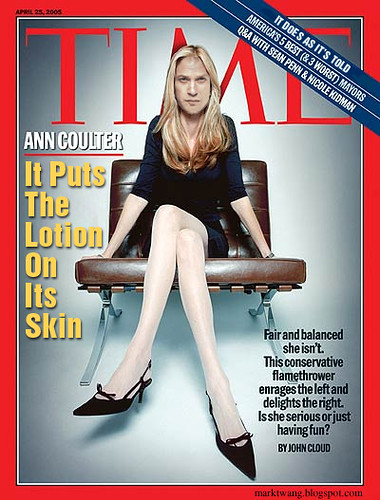
Coulter Culture

While publicizing her new book, If Democrats Had Any Brains They'd Be Republicans, Ann Coulter recently spoke with George Gurley of The New York Observer about her stand on particular issues (click here for parts of the interview). What she had to say about women particularly caught my eye (/made me want to hunt her down and knock some sense into her closed-off right-winged mind):

"If we took away women's right to vote, we'd never have to worry about another Democrat president. It's kind of a pipe dream, it's a personal fantasy of mine, but I don't think it's going to happen. And it is a good way of making the point that women are voting so stupidly, at least single women.
It also makes the point, it is kind of embarrassing, the Democratic Party ought to be hanging its head in shame, that it has so much difficulty getting men to vote for it. I mean, you do see it’s the party of women and 'We’ll pay for health care and tuition and day care -- and here, what else can we give you, soccer moms?'"

Coulter often uses shock tactics like these to persuade people into her way of thinking. By condemning her own gender (essentially saying that she is willing to have her right to vote taken away because so many other women vote with their hearts and sense of compassion rather than their heads) she clearly emphasizes her disdain for Democrats. While in a sense it is effective verbal rhetoric, in my opinion, it is also an example of verbal rhetoric taken too far. In coming across as a woman condemning her own, she utilizes ethos to essentially say to others "as a woman, I can say that in fact we are too emotional and stupid to vote." A male may look at this as justification for not taking women seriously in politics, and it may even cause other females to doubt themselves. Coulter's words have the serious potential to set back a group that she herself is a part of, potentially (and ironically) diminishing her ability to be taken seriously in the political ring.

(The above photo did not appear with the article, but I find it particularly appropriate:).)

Sunday, September 30, 2007

The Iconic IED

The caption to this Sept. 30 Washington Post article caught my eye:

"The IED is the signature weapon in Iraq and Afghanistan, as iconic as the machine gun in World War I or Persian Gulf War's laser-guided "'smart bomb.'"

I suppose this struck me because it's interesting to think of an "icon" as a weapon. If I were to think of the icons of, say, WWII, I would think of Rosie the Riveter, or the picture of the raised flag at Iwo Jima, or other similarly inspiring and patriotic icons of the time. But in thinking that, I realize that I have almost been sucked into the propaganda that those strong, upbeat images are meant to convey. Perhaps the result of labeling a weapon the "icon" of a war evokes the truer meaning of war itself, bringing to light its dark side, which should not be ignored.

Wednesday, September 26, 2007

Swastika From Above

This swastika-shaped building complex is a U.S. Naval barracks in Coronodo, California whose unfortunate shape was discovered by the all-seeing eye of Google Earth. The buildings were built in the 1960s, and according to the Navy, the shape wasn't discovered until the project had already broken ground, which according to the Switched article, made it too late to modify the designs.

The revelation of this shape caused a number of conspiracy theories to arise. According the article, the buildings sit at the intersection of Tulagi and Bougainville, two streets named after famous WWII battles. Another theory in a different report is that the buildings turned sideways are actually hiding Calvary crosses, which, when combined with the swastika, relate very much to the Schlageter Memorial (Albert Schlageter being an icon for the Nazi youth pre-World War II.) Still another believes that the crosses point in a direct line to Jerusalem.

As a result of the controversy caused by this aerial discovery of this building, the Navy plans to spend upwards of $600,000 to camouflage the structure with landscaping, walkways and solar cells, all of which will hide the offending shape from aerial views. In my opinion, this further proves that well-known symbols such as the swastika can not ever truly be "re-owned," and will instead always carry the cultural meaning that has been assigned to them.

Sunday, September 23, 2007

Suing God

I recently read an article in the Washington Post about a state senator from Nebraska who was so sick and tired of people suing everyone for everything that he decided to make a point by suing God. The senator, Ernie Chambers, cited that God had made terroristic threats against him and his constituents, inspired fear, and caused "widespread death, destruction and terrorization of millions upon millions of the Earth's inhabitants." (Click here for full article.)

The article struck me for two reasons. One, it is a clever form of verbal rhetoric attempting to appeal to people's common sense by relying on shock-value tactics. The second reason is the photo that the Washington Post deliberately chose to include with the article. This photo is not a photo of Sen. Chambers during his lawsuit. Rather, it is an AP file photo from April 12, 2006 that shows the senator in the middle of a debate in the legislative chamber in Lincoln, Neb. Positioned behind his head is what appears to be a rotating fan, but when looking at the picture as a whole, has a definite halo look to it.

While this may have been the Post's attempt at humor (which is how I took it), I think there is also the potential for the religious undertones of the photo to impact the story. By making it look like Sen. Chambers is wearing a halo, it appears as though he is on God's level, and thus, is able to sue Him. This could potentially further offend readers who may have already found offense in the Senator's actions. On the flipside, it may also mock the Senator's method of making his point.

(As a side note, interestingly enough, when I went to go to the page to write this response, the image was no longer available. I'm not sure if it's my computer or not, but perhaps some offense was taken by one party or another?)

Friday, September 21, 2007

Petraeus or Betray Us?


The text reads:

General Petraeus or General Betray Us?
Cooking the Books for the White House
General Petraeus is a military man constantly at war with the facts. In 2004, just before the election, he said there was "tangible progress" in Iraq and that "Iraqi leaders are stepping forward." And last week Petraeus, the architext of the escalation of troops in Iraq, said, "We say we have achieved progress, and we are obviously going to do everything we can to build on that progress." Every independent report on the ground situation in Iraq shows that the surge strategy has failed. Yet the General claims a reduction in violence. That's because, according to the New York Times, the Pentagon has adopted a bizarre formula for keeping tabs on violence. For example, deaths by car bombs don't count. The Washington Post reported that assassinations only count if you're shot in the back of the head -- not the front. According to the Associated Press, there have been more civilian deaths and more American soldier deaths in the past three months than in any other summer we've been there. We'll hear of neighborhoods where violence has decreased. But we won't hear that those neighborhoods have been ethnically cleansed. Most importantly, General Petraeus will not admit what everyone knows: Iraq is mired in an unwinnable religious civil war. We may hear of a plan to withdraw a few thousand American troops. But we won't hear what Americans are desperate to hear: a timetable for withdrawing all our troops. General Petraeus has actually said American troops will need to stay in Iraq for as long as ten years. Today, before Congress and before the American people, General Petraeus is likely to become General Betray Us.

This ad was placed in the New York Times on September 10 by liberal anti-war group MoveOn.org. While it attempted to draw attention to the allegedly skewed facts of Patraeus' report to Congress, the ad instead "angered Republicans." Rep. Duncan Hunter of California, a presidential candidate, brought the ad to the September 10 Patraeus hearing and waved it in the air, telling lawmakers he was "irritated" by it. Senator Gordon Smith, one of the few Republican senators who supports legislation ordering troop withdrawals, told reporters that "Petraeus' testimony and the MoveOn.org ad were the two biggest factors in keeping Republicans from breaking ranks with the president: Petraeus' testimony because it was persuasive and the MoveOn ad because it went too far by attacking a popular uniformed officer" (breitbart.com).

While attempting to utilize both logos and pathos (by making the public question whether or not they were being betrayed by a trusted official), MoveOn.org's piece of visual/verbal rhetoric also had the effect of evoking anger from public officials
to the point where the very next week they voted 72-25 to officially condemn the ad. This reaction of "how dare Americans question what we are telling them" seems frighteningly Big Brotherish to me, and almost a violation of the very freedoms that the troops in Iraq are supposedly fighting to defend.

Unfortunately, this piece of rhetoric also served as "a life raft for the Republican party as the war debate kicked into high gear. With several Republicans opposed to President Bush's war strategy, GOP members were able to put aside their differences and rally around their disapproval of the ad" (USA Today). It seems a shame to me that the same passion and fervor in developing and passing legislation could not be applied to more important issues, but perhaps this was also MoveOn.org's point--that the U.S. government cares more about its image than getting anything real accomplished. But, on the other hand, does a piece of rhetoric that serves to unite the very people it is speaking out against truly serve its purpose?

Monday, September 17, 2007

Leave Nothing

This new Nike commercial has been played throughout the 2007 football season thus far. As a football fan, I can't help but get chills everytime I see it. As a student of rhetoric, I can't help but notice the blatant use of pathos that elicit strong feelings towards the sport of football. The music in the background is from the Last of the Mohicans soundtrack, and as LT, Shawn Merriman, and Antonio Gates plow down the field through other players and the elements, the rhythmic battle music crescendos, growing in intensity. As the featured players hit other players, the noise of the hit and heavy breathing conveys how hard they are working; this is the only language spoken in the entire commercial. The dramatic cutoff at the end of the commercial shows the audience that leaving it all on the field means everything; not that winning doesn't matter, but that the players on the field should be emulated and honored for leaving nothing behind, much as we do our battle heroes. Considering our nation's out and out obsession with the sport, I'm actually considering exploring the use of rhetoric in football and its related propaganda for my final project.

Tuesday, September 11, 2007

Ethos

This old ad utilizes ethos, or "credibility," to entice consumers to smoke cigarettes by saying that doctors prefer them. By associating this particular brand with the authority that doctors have in determining what is healthy and what is not, this appeal attempts to associate Camel cigarettes with health, and thus encourage people to smoke this brand because it is healthier. Today, this ad is quite humorous, as we now know that the true health effects of smoking make it something that a doctor would never condone.