Sunday, October 28, 2007

Dumbledore is Gay!

This post on VH1's Best Week Ever's website is poking fun at the cultural phenomenon shocker that was JK Rowling's revelation that Dumbledore of the Harry Potter series is gay.

A funny parody of ex-NSyncer Lance Bass's cover of People magazine revealing the very same information, this cover comments effectively on the international shockwave that the author created in her outing of the famous character. The fact that this information was at the forefront of a good number of news shows also makes a statement about the power behind JK Rowling's words. By envisioning her beloved character as gay from the beginning of the series, and revealing it so nonchalantly in an interview, Rowling actually has the brilliant effect of teaching tolerance to the range of generations that read her novels. Thus, Rowling uses pathos through her readers' connection to her characters to convey her message.

Friday, October 26, 2007

Reality TV?

The Hills is a show on MTV that allegedly falls under the "reality" genre, but seems to be crafted relatively less realistically. In a recent episode, fans were able to see just how "real" the show truly is, as the main character's fingernails magically went from painted to unpainted in two consecutive scenes that supposedly took place within a manner of minutes.

While many people have questioned how real reality tv truly is, by attempting to pass clearly crafted shows like this off as reality tv, are producers and directors redefining the word itself? To me, it seems as though they and the willingness of the audiences who watch it to accept it as such have created a new cultural meaning of the word in society today. We are willing to accept "reality" as something where tribes of half-starved Americans are sent to a deserted island and pitted against one another in obstacle course-style games to win a million dollars. Or, where dozens of gorgeous girls can fall in love with one devastatingly handsome man over the course of a 3 months time. Even the people in these shows aren't "real" anymore--many are out-of-work or up-and-coming actors and actresses trying to get noticed. It seems to me that the definition of "reality" has become what we are willing to believe, rather than what is actually there; yet, it is a change in meaning that we are either too ignorant or too unwilling to recognize. For even as much as I know that the marginally educated cast of The Hills actually do not have fabulous jobs as record executives and fashion magazine editors at the ripe ages of 20 and 21, I (and I would be willing to bet a number of people like me) continue to watch and yearn for a "real" life as fabulous and glamorous as theirs.

Monday, October 22, 2007

Colbert for President

Stephen Colbert is everywhere right now. On his television show The Colbert Report, a parody of Republican talk shows very similar to Jon Stewart's The Daily Show, Colbert announced last week that he plans to run for president in both the Democratic and Republican primaries. While intended as satire, a large number of people were seriously interested in the idea, according to a recent national poll conducted by Public Opinion Strategies, a Republican polling firm.

The firm polled 1,000 likely 2008 voters included Stephen Colbert's name in both the GOP and Democratic primaries. In the Democratic primary, Colbert took 2.3 percent of the vote -- good for fifth place behind Sen. Hillary Rodham Clinton (40 percent), Sen. Barack Obama (19 percent), former Sen. John Edwards (12 percent) and Sen. Joe Biden (2.7 percent. Colbert finished ahead of Gov. Bill Richardson (2.1 percent), Rep. Dennis Kucinich (2.1 percent) and former Sen. Mike Gravel (less than 1 percent).

He was less lucky in the Republican field, where he took less than 1 percent of the vote behind even longshot candidates like Reps. Tom Tancredo and Ron Paul. Former New York City Mayor Rudy Giuliani led the Republican field with 29 percent, followed by former Gov. Mitt Romney at 12 percent, former Sen. Fred Thompson (11 percent) and Sen. John McCain (10 percent).

While obviously Colbert will not be president anytime soon, I think that this exercise is a clear demonstration of how well people respond not just to comedy, but to a sense of "truthiness" (to quote the man himself) in the political arena. Because people like Jon Stewart and Stephen Colbert are unafraid to point out the flaws of today's politicians, they appeal to people's sense of logic and trust, which is something that is often lacking in other candidates' campaigns due to their struggle to appear as the best of the bunch. Thus, through satire, Colbert and Stewart successfully utilize logos and pathos to outsmart the political game and truly convince a significant portion of America that they are the people to trust when it comes to making sense of it all.

Wednesday, October 17, 2007

Flaming Pope

The iconic figure of Pope John Paul II was allegedly spotted in the flames of a fire during a ceremony in Poland that marked the second anniversary of his death (see this article for details). The fact that it made international news alone speaks to the power of iconic imagery to make people who may not think something like religion is real actually consider that it could be. On the other hand, the fact that such a huge deal was made out of something that very easily could have been manufactured may also work against the Catholic Church, making it seem as unrealistic and contrived as some people believe it to be. I think this photograph is an interesting comment on how trust in photographs and interpretation of them can and do play a significant role in the acceptance of beliefs such as religion, ironically serving as "proof" of the faith that is supposed to exist without it.

Thursday, October 11, 2007

This Is For The Soldiers

Remember Me

I think the use of music is interesting when comparing these two videos. The slower music in Remember Me definitely evokes a sense of sympathy and compassion, while the more intense metal music in This Is For The Soliders almost evokes a sense of anger. Both of the videos were produced by the same person and involve the same subject matter and similar photos, yet the music has the power to influence the message significantly. While I felt for the soldiers and their sacrifice in Remember Me, the metal music in This Is For The Soldiers reminded me of the violence and anger associated with war, which diminished my sympathy a bit. The point of This Is For The Soldiers had a lot to do with the fact that the band Drowning Pool was so moved by the soldiers and what they are doing that they created a song for them, but the intensity inherent in the type of music they produce does take away from the sympathy that these montages are attempting to elicit.

Tuesday, October 9, 2007

Don't Tase Me Bro

Recently, a college student was tasered by security guards at a John Kerry speech because he refused to keep quiet or leave the auditorium when asked. In order to prevent the security guards from coming near him with the tasers, the student yelled "Don't tase me, bro" at them. While the debate continued over whether or not the security guards were correct in their actions, the video of the event (and particularly that catchphrase) became a YouTube sensation, and as always seems to happen, the parodies abounded (the above is an example of one of the more hilarious versions.)

While we can all find humor in parodies like these, I think it raises the question of whether or not they serve as a form of rhetoric themselves. Some viewed this event as a serious threat to freedom of speech, but this parody makes it seem less serious, poking fun at the kid that actually was tasered pretty badly for speaking his mind. In lightening the mood surrounding this event, this parody seems to say that it should not be taken as seriously as it was by some, but it also takes away from the seriousness of the free speech debate surrounding it, perhaps also making it a comment on our generation's knack for forsaking concern for the things that matter in the pursuit of fun.

(Update 12/20/07: I just saw on the Today Show this morning that "Don't Tase Me, Bro" was deemed the top catchphrase of 2007. Interesting.)

Thursday, October 4, 2007

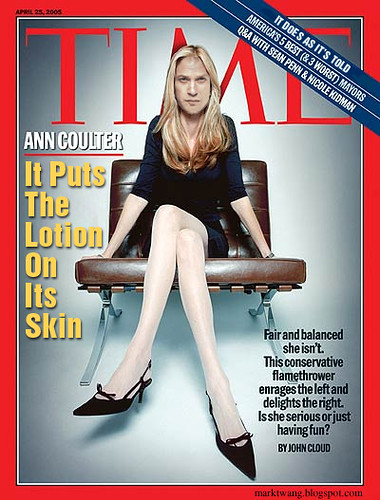
Coulter Culture

While publicizing her new book, If Democrats Had Any Brains They'd Be Republicans, Ann Coulter recently spoke with George Gurley of The New York Observer about her stand on particular issues (click here for parts of the interview). What she had to say about women particularly caught my eye (/made me want to hunt her down and knock some sense into her closed-off right-winged mind):

"If we took away women's right to vote, we'd never have to worry about another Democrat president. It's kind of a pipe dream, it's a personal fantasy of mine, but I don't think it's going to happen. And it is a good way of making the point that women are voting so stupidly, at least single women.
It also makes the point, it is kind of embarrassing, the Democratic Party ought to be hanging its head in shame, that it has so much difficulty getting men to vote for it. I mean, you do see it’s the party of women and 'We’ll pay for health care and tuition and day care -- and here, what else can we give you, soccer moms?'"

Coulter often uses shock tactics like these to persuade people into her way of thinking. By condemning her own gender (essentially saying that she is willing to have her right to vote taken away because so many other women vote with their hearts and sense of compassion rather than their heads) she clearly emphasizes her disdain for Democrats. While in a sense it is effective verbal rhetoric, in my opinion, it is also an example of verbal rhetoric taken too far. In coming across as a woman condemning her own, she utilizes ethos to essentially say to others "as a woman, I can say that in fact we are too emotional and stupid to vote." A male may look at this as justification for not taking women seriously in politics, and it may even cause other females to doubt themselves. Coulter's words have the serious potential to set back a group that she herself is a part of, potentially (and ironically) diminishing her ability to be taken seriously in the political ring.

(The above photo did not appear with the article, but I find it particularly appropriate:).)